Beginner / Project walkthroughs
Package a Browser Game as a Runnable Source Download
A source download is useful only if it contains everything required to run the example. An engine module by itself may look complete but still import helpers, rely on browser controls, or load a stylesheet that was left out of the archive.
What you'll build
We will inspect the structure of the runnable game ZIPs provided by this site and verify them independently of the website. The same principles apply when sharing a plain HTML, CSS, and JavaScript project without a framework.
Prerequisites
Know relative file paths and JavaScript imports. Download a project from its demo page and inspect the archive before running it. The shipped package includes a local entry page, styles, original modules, and a generated classic browser bundle.
Start from the entry page
The archive's index.html references local CSS and assets/js/demo-bundle.js. It does not depend on the main site's navigation, privacy panel, or root-domain routes. This keeps a learning example usable after extracting it into an arbitrary directory.
The classic bundle supports direct-file opening in browsers that restrict ES-module imports from file://. Original modules remain included for reading and editing. If you work directly with those modules, serving the directory over HTTP is the more appropriate development path.
Do not solve direct-file errors by removing module boundaries from the source you teach. A generated playback artifact and readable module source can serve different purposes as long as the relationship is documented.
Include transitive dependencies
demo.js imports all four engine factories because the wrapper supports all demo modes. A package that includes only the selected engine would therefore have missing imports if it tried to run the original module entry unchanged.
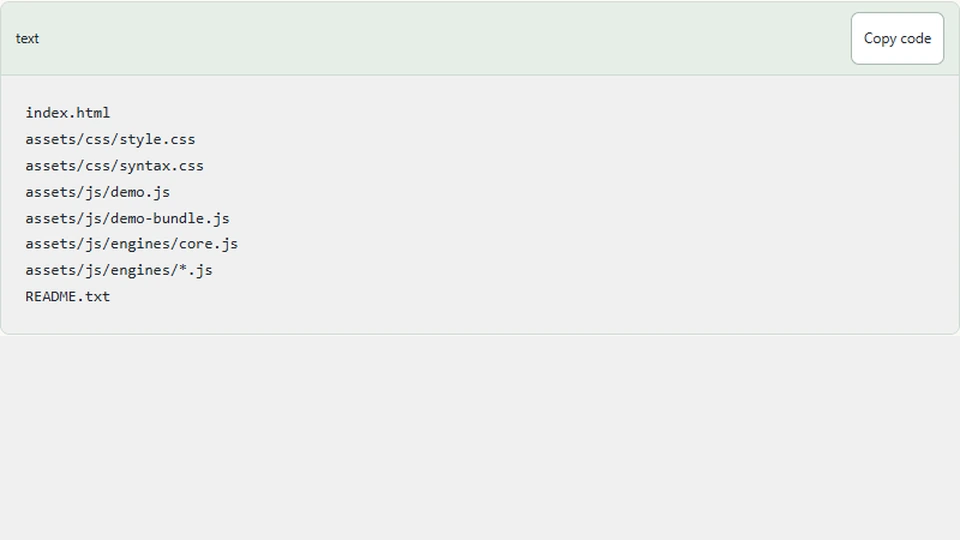
The existing archives include the engine modules and their shared core. They also include the syntax stylesheet referenced by the main stylesheet. That second dependency is easy to miss because it is a CSS import rather than an HTML script tag.
index.html
assets/css/style.css
assets/css/syntax.css
assets/js/demo.js
assets/js/demo-bundle.js
assets/js/engines/core.js
assets/js/engines/*.js
README.txt
This is a dependency inventory, not a requirement to use these exact folder names. The important property is that every referenced path resolves inside the extracted package.
Avoid accidental website dependencies
A local source example should not load an absolute /assets/... path that only exists at the main website's root. A file opened from disk can interpret that as a drive-root path; a project served under a subdirectory can resolve it to the wrong host location.
Use paths relative to the entry page or stylesheet where appropriate. Test from a directory different from the repository root so hidden dependencies do not succeed merely because the rest of the site happens to be nearby.
The package does not need the live site's analytics or advertising integration to explain game rules. Keeping those concerns out also makes network behavior easier to inspect during a local learning exercise.
Make the archive reviewable
Include short run instructions and clear source permissions. The current downloads allow inspection and local learning under the site's Terms; they do not silently assign an open-source license that the owner has not chosen.
A reproducible archive uses fixed metadata for unchanged files so rebuilding does not alter its bytes solely because of ZIP timestamps. That makes release comparisons easier, though it is not a substitute for checking the actual code content.
If the visible game changes, update the downloadable bundle and original modules together. A tutorial that links to an old archive can remain misleading even when its on-page snippets are current.
Test the delivered artifact
Extract the actual ZIP, not a hand-picked source folder. Open its entry file directly, then serve the extracted directory over HTTP and repeat the test. Check the console and network panel for missing files, not only whether the Start button appears.
Try Start, Pause, Resume, difficulty, palette, and keyboard controls. Those operations exercise the wrapper and modules beyond initial rendering. The site's browser test performs an independent extracted-package check for this reason.
Next steps
Open Memory Match's download and trace every path from its entry page. When sharing your own project, treat the archive as a small product with its own entry point and documentation. “The files exist somewhere in the repository” is not enough to make a download runnable.