Beginner / Game state & scoring
Treat Game Difficulty Settings as Reviewable Data
A difficulty selector becomes hard to maintain when every option is a separate game page with a few constants changed. The current demos instead accept a difficulty value inside one engine instance and keep visual palette choices separate from rule changes.
What you'll build
We will inventory the real difficulty parameters across the four engines and design a data-oriented alternative to scattered formulas. The existing factory arguments remain the starting point; the proposed settings object is an extension for easier tuning.
Prerequisites
Understand factory arguments and basic objects. Each engine receives a difficulty number from zero through five. The wrapper recreates the round when that selector changes, while changing the palette only redraws the existing state.
List what difficulty actually changes
Memory uses 6 + difficulty % 3 pairs. Its six selector levels therefore repeat three board sizes; they are not six unique memory algorithms. Collector changes its gem goal, spawn interval, falling speed, and hazard probability. Racer changes its target, spawn interval, and falling speed. Timing changes its hit target, zone width, and angular speed.
This inventory prevents vague claims such as “every level is faster” when that is not true for memory. It also reveals parameters that compound. Timing becomes harder through a narrower window and faster motion, while Collector combines more required gems with more hazards.
Palette is not difficulty. It belongs to drawing rather than scoring or physics. Keeping the selectors independent avoids creating near-duplicate public pages for combinations that are only presentation choices.
Extract a settings object when it improves review
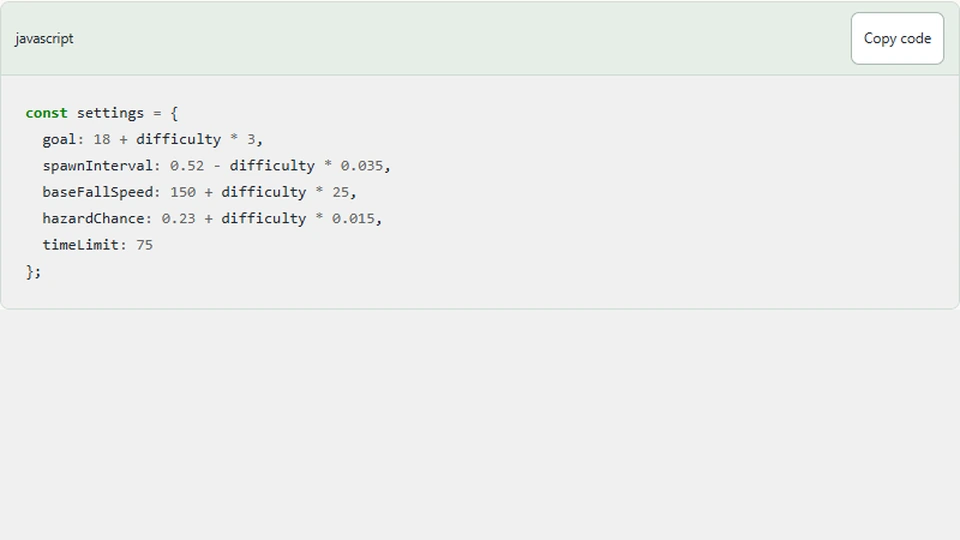
Formulas are compact, but named values can make balancing discussions easier. A collector factory could derive its settings once and use the object throughout update:
const settings = {
  goal: 18 + difficulty * 3,
  spawnInterval: 0.52 - difficulty * 0.035,
  baseFallSpeed: 150 + difficulty * 25,
  hazardChance: 0.23 + difficulty * 0.015,
  timeLimit: 75
};
This sketch names the existing collector formulas; it does not introduce a new balancing system. If you later replace formulas with hand-tuned presets, the rest of update can continue reading the same names.
Validate values at the boundary if settings become external data. A negative interval or out-of-range probability can produce behavior that is technically executable but not meaningful. Internal selector constraints currently keep the supplied difficulty within its intended range.
Reset when rules change
The wrapper returns to a ready state after a difficulty change. It does not preserve an old score while replacing the target midway through the round. That makes comparison between settings easier and avoids questions such as whether an already completed target should immediately award a win.
A live difficulty adjustment can be valid, but it needs a clear transition policy. Decide what happens to existing objects, spawn remainder, elapsed time, and lives. Reusing one selector event without considering those fields can create a hybrid round that matches neither setting.
Compare challenge, not only constants
Increasing speed does not guarantee a predictable difficulty increase. More frequent objects can create more scoring opportunities as well as more hazards. A smaller target window can interact with a faster sine wave. Evaluate combined behavior rather than assuming each parameter has an independent effect.
Use repeatable random sequences when comparing variants, and record the starting settings with results. A few casual runs are useful observations, not proof that a setting is balanced for every player or device.
For memory, compare board sizes explicitly. Repeated level labels can be simplified to pair-count labels in a future UI revision without changing the engine's underlying state model.
Test the configuration boundary
Create each engine at all six supported values. Verify targets remain positive, intervals remain valid, the board has the expected card count, and the timing zone remains visible. Then check restart and completion at more than the easiest setting.
Also confirm palette changes do not reset score or change target values. That test protects the separation between visual preferences and game rules, which is the main reason one demo can replace many superficial editions.
Next steps
Read the Collector source and extract the current parameters into a table before editing them. Make one balancing change at a time and keep its intended effect measurable. A settings object is useful when it clarifies those decisions; it is not a substitute for deciding what the game should ask players to do.