Why Restarting Neon Pairs Changes Your Memory Strategy
Understand the reshuffled board, count a move correctly, and build a fresh location map after each restart.
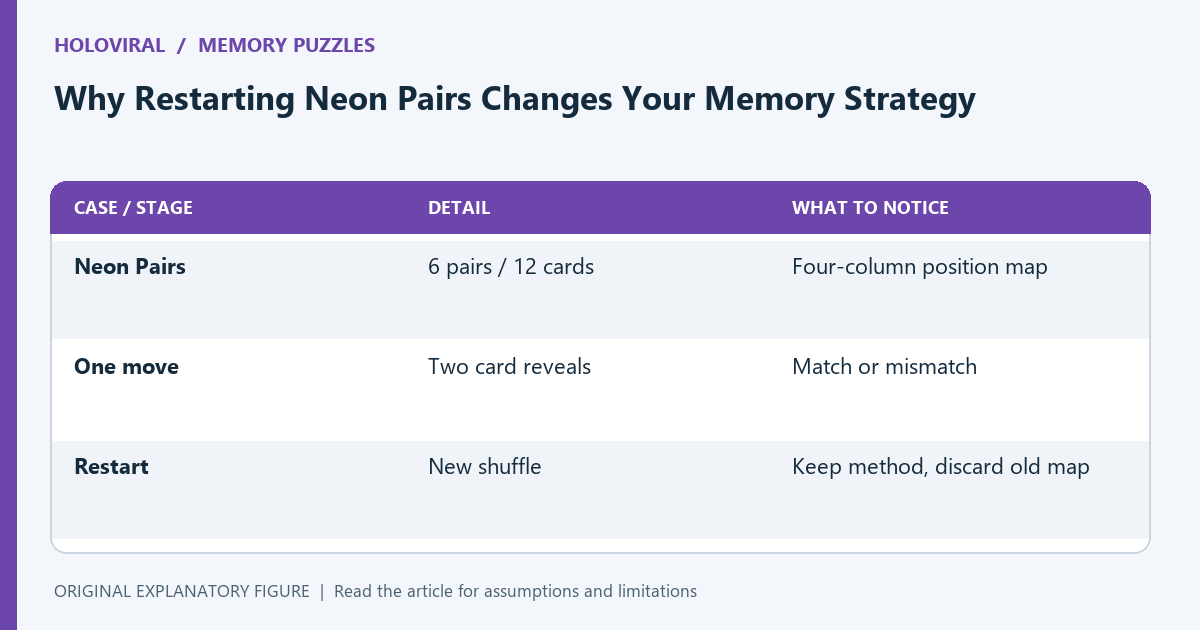
A restart in Neon Pairs resets more than the move counter. The bundled game creates a newly shuffled board, so the positions you remembered in the previous attempt are no longer a reliable map. This guide follows the local memory-game implementation and explains how to practice across fresh boards. The suggestions are strategy experiments, not guaranteed ways to reach a perfect score.
Read what the board measures
Neon Pairs has six pairs, giving twelve cards. The move counter increases after you reveal two cards, whether they match or not. One isolated reveal is not yet a completed move. Matched cards remain visible and no longer need to be searched.
The game has no countdown. You can think before choosing the next card. Do not transfer the time pressure of an arcade game into this board unnecessarily. A deliberate pause can be part of a useful location-based strategy.
Discard the old position map after restart
The local game shuffles the card entries when you start a new board. A star in the upper-left position in one run does not establish that the next run starts with a star there. Keep the strategy, not the old coordinates.
For example, retain “name positions by row and column,” but discard “the circle is at row two, column three.” This distinction explains why a restart may feel harder even when you have just completed the previous board.
Build a small map from actual reveals
Use the four-column layout to give positions simple names. After a mismatch, recall both symbols and their locations. If you later reveal one of those symbols elsewhere, you can return to its known partner rather than guessing again.
Keep the map modest. Trying to memorize every unseen possibility is unnecessary. The board only gives you evidence when you reveal a card. Distinguish a known location from a guess so the next move has a clear basis.
Use the mismatch interval constructively
A mismatched pair stays visible briefly before turning back. The implementation uses an approximately 850-millisecond delay. During that interval, notice the positions instead of tapping additional cards; the board is temporarily locked.
You do not need to race the interval if you are already naming the first reveal before choosing the second. Try saying a short internal label for each position. If that distracts you, use a different memory cue and compare a few boards.
Compare strategies across several boards
Record the move count and the strategy used, not a claim that every shuffled board was equally easy. Some arrangements may reveal useful pairs early. A single lucky board cannot establish that a method is better.
Try a row-based naming strategy for several runs, then a corner-based strategy. Keep the device and controls stable. Use the game-page notebook for a short observation if helpful. The useful result is a repeatable cue you can apply on a fresh board, rather than memorized coordinates from the previous run.
| Case or stage | Detail | What to notice |
|---|---|---|
| Neon Pairs | 6 pairs / 12 cards | Four-column position map |
| One move | Two card reveals | Match or mismatch |
| Restart | New shuffle | Keep method, discard old map |