Turn a Lost Arcade Round Into One Testable Question
Describe the final decision, choose one change, and use a second round to investigate it without chasing an unlimited retry streak.
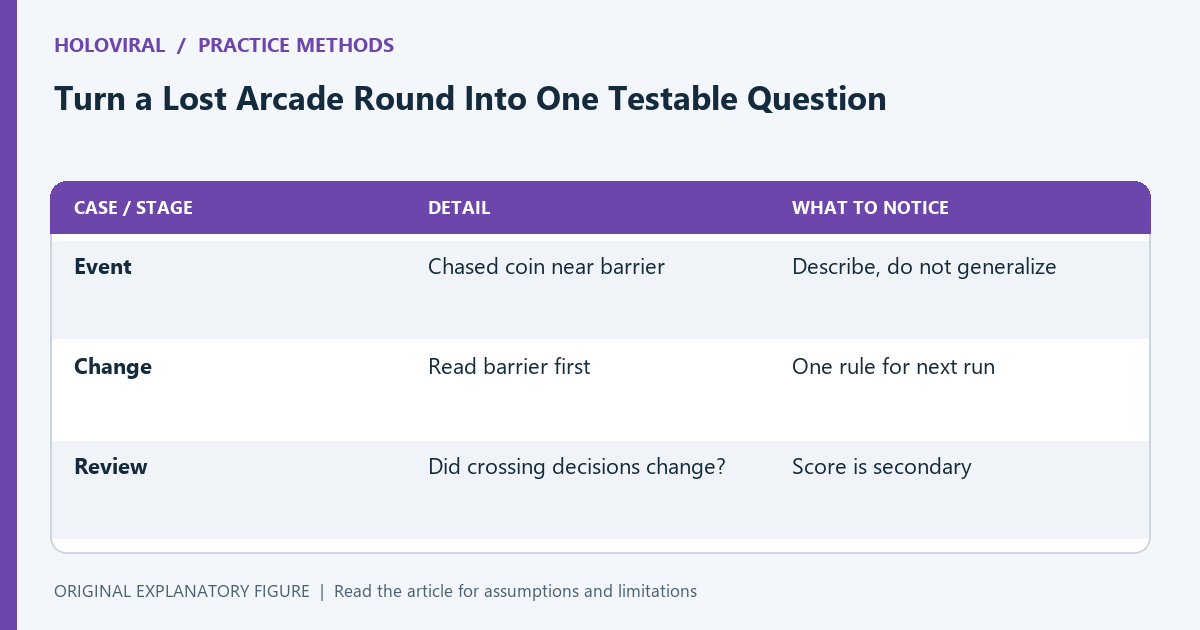
A lost round can leave you with a vague impression that you need faster reactions. A more useful review identifies one decision you can investigate. This guide uses the bundled lane racer and collector games, but it is a practice method rather than a promise of higher scores. Keep the session short enough that the next round remains a deliberate test.
Describe the event before judging it
Write what happened in observable terms: “changed lanes toward a coin while a barrier was approaching.” That is more useful than “played badly.” Include where your attention was and what you noticed too late.
You do not need a complete replay. One event can support a practice question. If you cannot identify the cause, record the uncertainty instead of inventing an explanation from the final score.
Choose one change
For the lane example, the change might be “watch the next barrier before deciding about a coin.” For a collector, it might be “ignore gems that require crossing a hazard path.” Keep the rule small enough to remember during play.
Do not combine slower movement, a new device, a different edition, and a new strategy in the same test. If the outcome changes, you will not know which adjustment contributed. Keep the rest of the setup stable when practical.
Define the observation you will compare
Count or describe the relevant event, such as avoidable crossings toward a reward. The final score can remain a secondary observation. A safer strategy may initially collect fewer rewards while you learn it.
Use a small private note, not a public claim about an optimal technique. Random object patterns mean a single round is weak evidence. You are looking for a decision you can apply, not proving that the game always rewards it.
Set a stopping point
Choose a limited number of attempts or a short session window before restarting. If the test becomes frustrating or you stop observing the chosen event, end the session. More retries do not automatically produce more useful information.
At the stop point, write whether the rule was easy to apply and what remained unclear. A useful session can end with a better question rather than a win. That keeps practice separate from an open-ended pursuit of a personal best.
Carry forward only the useful note
Keep one sentence that informs a later round, such as “coins are optional when the next barrier blocks the route.” Remove notes that merely criticize the outcome. If the rule did not help, state that and choose another question next time.
Use Neon Drift or Orbit Collector for the exercise and the game-page notebook when available. Notes are browser-local in the existing workflow, so they are not a cloud backup. The result should be a repeatable observation you can test again, with its uncertainty still visible.
| Case or stage | Detail | What to notice |
|---|---|---|
| Event | Chased coin near barrier | Describe, do not generalize |
| Change | Read barrier first | One rule for next run |
| Review | Did crossing decisions change? | Score is secondary |