Read a Game Page Before Trusting an Animated Walkthrough
Separate illustration, recorded play, controls, and success conditions when using a tutorial to learn a browser game.
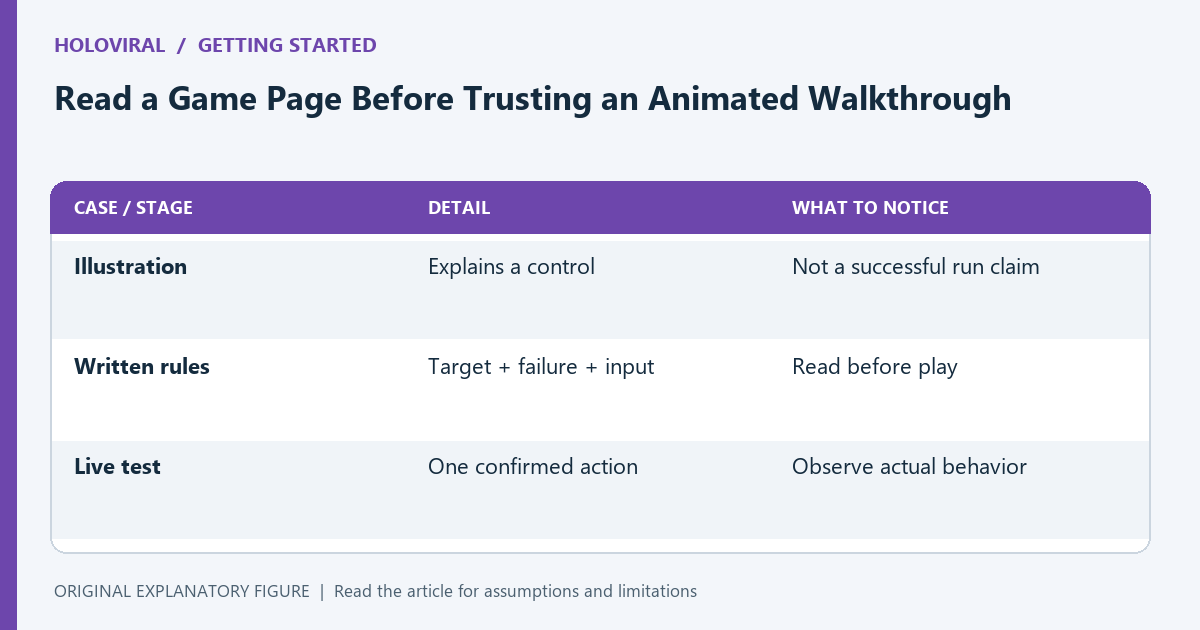
An animated walkthrough can explain a control without showing a real successful run. That distinction matters when you are trying to learn timing, scoring, or difficulty. HoloViral’s original guide assets illustrate controls and are labeled accordingly. This article shows how to combine them with written rules and a short test round rather than treating every animation as gameplay evidence.
Identify what the guide claims to show
Read the guide’s label and nearby explanation. A control illustration may show a collector moving under a gem or a ring crossing a zone. It need not reproduce the exact pace, random pattern, or scoring of a live round.
Keep recorded gameplay separate from a diagram or animation. Both can be useful, but they answer different questions. A visual example of movement does not establish that the demonstrated path always works in the actual game.
Read controls and success conditions together
Find the input method, target, time limit when present, and failure condition. Knowing how to move is insufficient if you do not know what ends the round. In a collector, a bright object and a hazard demand different decisions.
Use the game page’s written rules as the starting record. If the illustration and current rules differ, follow the current game instructions and note the discrepancy rather than inventing a hidden rule to make both appear consistent.
Test one control in a low-pressure attempt
Begin a short run with the purpose of confirming the input. For a collector, move left and right without chasing every gem. For a memory board, reveal one pair and inspect how the move counter changes.
The goal is to connect the written instruction to an observed event. Do not judge the whole tutorial from whether the first attempt wins. A failed round can still confirm the control and reveal the actual pacing.
Use the animation for the specific confusion
Replay the portion that explains the action you did not understand. Pause the guide if needed. Then return to the same game and try that action with the live rules visible in mind.
Avoid repeatedly watching the full guide when the unresolved question concerns scoring or a particular failure. Those questions may need the written explanation or an observation in the player. Choose the evidence source that actually addresses the question.
Keep a short learning note
Record one confirmed control and one remaining question. A useful note says “dragging moves the collector directly; still learning safe routes.” It separates a known input from a strategy that needs practice.
Open Orbit Collector and compare its guide with its live controls. Use the related first-session article for a broader introduction. A tutorial is useful when it improves your understanding of the next action, with its illustrative or recorded nature clear rather than assumed.
| Case or stage | Detail | What to notice |
|---|---|---|
| Illustration | Explains a control | Not a successful run claim |
| Written rules | Target + failure + input | Read before play |
| Live test | One confirmed action | Observe actual behavior |