Compare Six-Pair and Eight-Pair Memory Boards Fairly
Include board size and moves per pair when reviewing the bundled memory editions instead of comparing raw move counts alone.
A larger memory board gives you more positions to remember and more pairs to complete. Comparing two raw move counts without noting board size can make the result misleading. This guide uses the bundled Neon Pairs and Gem Match editions. It introduces a simple descriptive ratio while keeping shuffle luck and strategy differences visible; the ratio is not a scientific difficulty score.
Record the edition and pair count
The local memory engine uses six plus the variant remainder modulo three as its pair count. Neon Pairs has six pairs and twelve cards; Gem Match has eight pairs and sixteen cards. Both use the same two-card move counting rule.
Confirm the count in the status display before reviewing a run. A title alone may not be enough if an edition changes later. Pair count gives the raw move number a necessary context.
Know the theoretical minimum
If every two-card reveal finds a pair, a six-pair board needs six moves and an eight-pair board needs eight. That is a lower bound based on the rules, not a realistic promise for a fresh shuffled board with hidden cards.
The minimum helps explain why identical raw move counts do not mean identical performance. It does not account for how much information a player has already seen or whether early reveals happen to expose useful partners.
Use a descriptive ratio
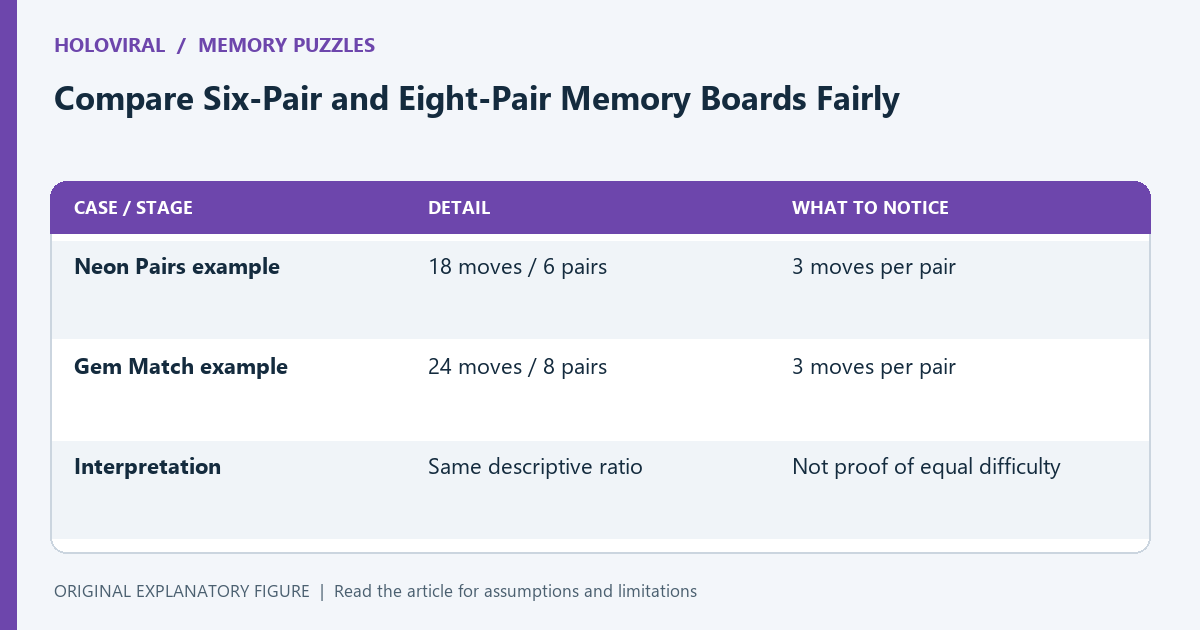
For invented results, eighteen moves over six pairs is three moves per pair. Twenty-four moves over eight pairs is also three moves per pair. The ratio makes the size difference visible.
It does not prove equal difficulty, skill, or learning. A larger board changes memory demands, and random layouts vary. Keep the raw count, pair count, and ratio together rather than replacing the original result with a single supposedly fair score.
Keep the practice conditions stable
Use the same device, position-naming method, and general pace when comparing editions. Avoid changing from row labels to free guessing while also switching board size. Several runs offer more context than one lucky board.
Record whether your errors came from forgetting positions or choosing unknown cards despite a known partner. That observation may be more actionable than the ratio. The numbers describe the run; they do not automatically identify the next improvement.
Use the comparison to choose a challenge
If the larger board creates too much confusion, practice the smaller one with a consistent location cue. If the smaller board feels comfortable, try the larger edition and keep the same cue.
Open Gem Match for the eight-pair example and the Neon Pairs guide for the shared rules. Treat moves per pair as a compact note, not a ranking of players. A useful comparison states the edition, board size, method, and limitations alongside the observed result.
| Case or stage | Detail | What to notice |
|---|---|---|
| Neon Pairs example | 18 moves / 6 pairs | 3 moves per pair |
| Gem Match example | 24 moves / 8 pairs | 3 moves per pair |
| Interpretation | Same descriptive ratio | Not proof of equal difficulty |