Compare Collector Editions by Goal and Hazard Pace
Read how the bundled collector variants change targets and falling-object behavior before comparing scores.
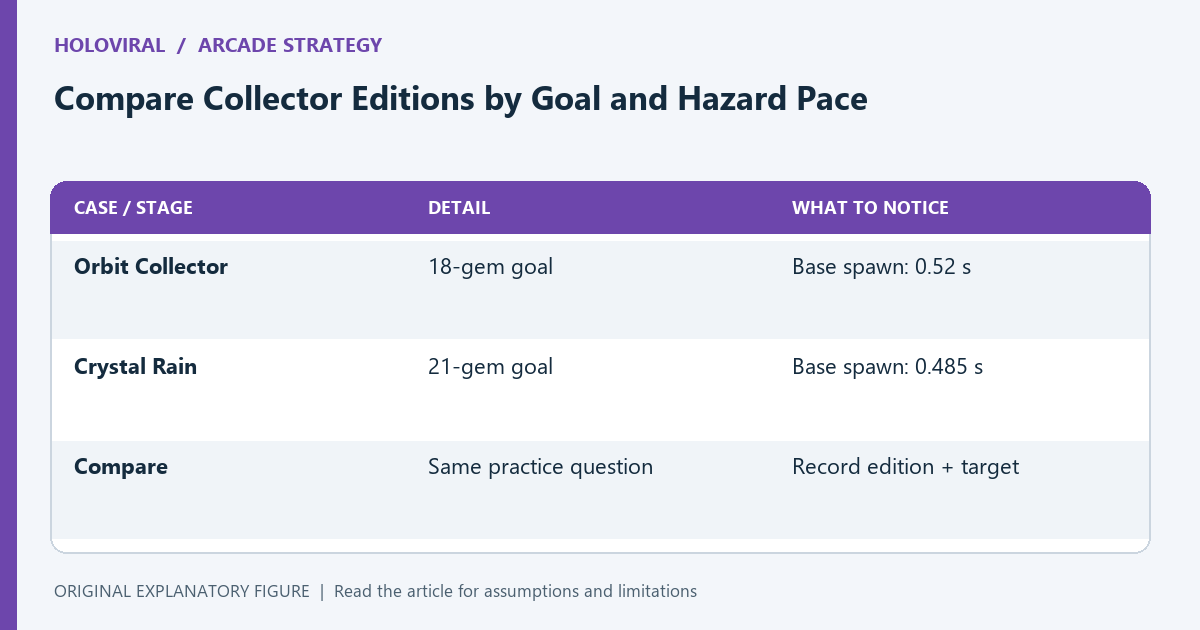
Orbit Collector and Crystal Rain share a collector-style control scheme, but their targets and pace differ. A raw score comparison can miss those differences. This guide reads the bundled engine’s variant settings and turns them into a practical comparison. It does not claim to benchmark difficulty scientifically or to describe provider-hosted collector games that use another engine.
Start with the shared task
In the original collector mode, you move horizontally, collect bright gems, and avoid red hazards. The run begins with three lives and has a seventy-five-second limit. You can use arrow keys, A/D, or dragging inside the arena.
These shared rules make the editions recognizable. They do not make every run identical: the engine generates falling objects with randomness. Read the target on the game page and status display before comparing outcomes from different editions.
Compare the target values
Orbit Collector uses variant zero and an eighteen-gem goal. Crystal Rain uses variant one and a twenty-one-gem goal. The engine’s target formula adds three gems per variant.
A score of eighteen therefore completes the target in the first edition but does not complete the second. Keep the target beside the score in your notes. A number only becomes interpretable when you know the success condition it is being compared against.
Notice the pace changes
The later collector variant starts with faster falling objects and a shorter spawn interval. The hazard probability also increases slightly. For Orbit Collector, the base spawn interval is 0.52 seconds; for Crystal Rain, it is 0.485 seconds in the code.
Actual animation timing depends on the running loop, and individual objects are random. Use these settings to understand why the second edition may demand earlier decisions, not to predict an exact number of gems or collisions in a session.
Keep the practice question stable
Try the same question in each edition: “Can I avoid crossing under a red object to chase a distant gem?” Use the same input method and a similar screen setup. Compare avoidable collisions rather than treating the final score as the only evidence.
Do not change strategy, controls, and edition at the same time if you want an understandable comparison. A lower score with fewer risky crossings may show a useful improvement in decision-making even when it does not produce a win.
Record the edition with the result
Write title, target, strategy, and one observed mistake. A note that says “twenty gems” is incomplete when one edition needs eighteen and another needs twenty-one. Keep the game-page notebook concise.
If the engine settings change in a future update, use the visible rules and current game instructions. This guide’s values describe the bundled version inspected for this article. The practical lesson remains: compare outcomes against each edition’s rules rather than assuming all collector scores mean the same thing.
| Case or stage | Detail | What to notice |
|---|---|---|
| Orbit Collector | 18-gem goal | Base spawn: 0.52 s |
| Crystal Rain | 21-gem goal | Base spawn: 0.485 s |
| Compare | Same practice question | Record edition + target |