Choose a Browser Game by Its Interruption Cost
Compare an untimed board, a paused moving game, and a provider game before starting a short session that may be interrupted.
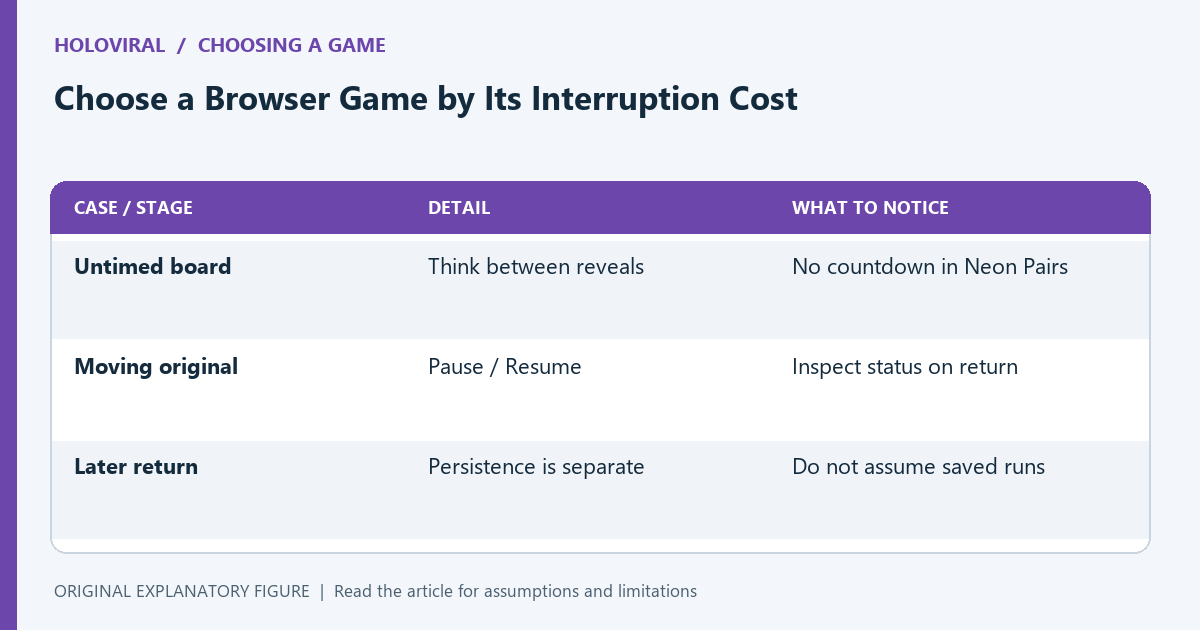
Two games can fit the same five-minute break and react very differently to an interruption. An untimed card board lets you think between turns; a moving challenge may need an explicit pause; another provider’s game may have its own rules. This guide helps you choose based on how easily you can stop and return, rather than assuming every browser game is equally suited to a fragmented break.
Name the likely interruption
Decide whether you expect a quick glance away, a short conversation, or leaving the device entirely. Those situations create different stopping needs. A pause button may suit a short interruption but cannot promise your run survives a closed tab or cleared browser state.
Keep the available time honest. If the break can end unexpectedly, favor a game whose stopping behavior you understand. A familiar control scheme matters less than knowing what happens when you need to leave.
Consider an untimed board
The bundled Neon Pairs board has no countdown and hides the arcade pause button. You can wait before revealing the next card. That makes a thinking pause straightforward, though the brief mismatch display still completes automatically.
Leaving and later reloading is a different question. This guide does not promise persistent run progress. If you need to stop between decisions without closing the player, the untimed structure offers a simpler interruption pattern than continuous falling objects.
Check a moving game’s pause behavior
The bundled collector, racer, and target modes provide Pause and Resume during an active run. The local engine also pauses non-memory play when its window loses focus. Read the status when returning and resume deliberately.
Do not assume those rules apply to every game in the collection. Provider-hosted games can have separate engines and controls. Before investing in a longer run, test the visible pause feature and note whether the game has a countdown or lives at risk.
Distinguish pause from persistence
Pause keeps an active session suspended in its current running page. Persistence means progress can survive navigation or a later visit. They are separate features. A page that saves your strategy note does not necessarily save the game state.
If a game advertises saved progress, read its own description and test the behavior appropriately. Avoid making a plan that depends on saving when the page only offers a pause. For a very uncertain break, a short self-contained round may be easier to finish.
Choose with the stopping point in mind
For a fragmented break, try an untimed board or a moving game with a pause control you have checked. For an uninterrupted window, choose a challenge whose run length fits. End with one note if you learned a useful rule.
Use the game collection to read descriptions and controls before starting. The selection goal is a session you can leave comfortably, not a claim that one genre is inherently better. Reassess when the game, provider, or device changes.
| Case or stage | Detail | What to notice |
|---|---|---|
| Untimed board | Think between reveals | No countdown in Neon Pairs |
| Moving original | Pause / Resume | Inspect status on return |
| Later return | Persistence is separate | Do not assume saved runs |